


Vietnam E7-3 Skilled Worker Supplier for South Korean Employers
Vietnam E7-3 Skilled Worker Supplier for South Korean Employers
The continued development of South Korea’s shipbuilding, mechanical engineering, component manufacturing, aviation, livestock, and food-processing industries has created growing difficulties for many employers seeking experienced and technically competent workers.
Unlike large-scale general labor recruitment, companies in these industries need workers who can understand technical instructions, operate tools and equipment, comply with workplace safety procedures, and quickly participate in production after arriving in South Korea.
For this reason, the demand for a professional Vietnam E7-3 skilled worker supplier has become increasingly important for Korean manpower companies, subcontractors, shipyards, factories, agricultural businesses, and other employers experiencing skilled labor shortages.
In 2026, the South Korean Ministry of Justice continued to adjust the E-7 visa policy according to labor market requirements. The government announced updated salary standards for E-7 visa holders and expanded certain occupations eligible under the E7-3 category.
This demonstrates that E7-3 is not a fixed recruitment program. It is an immigration and employment mechanism that may be adjusted according to industry requirements, labor shortages, economic conditions, and government policy.
What Is the South Korean E7-3 Visa?
E7-3 is a subcategory of South Korea’s E-7 visa system. It applies to foreign workers performing designated skilled occupations approved by the South Korean government.
In the E-7 occupational classification document provided for this article, E7-3 is translated as the category for general skilled workers and includes 14 approved occupations. The Vietnamese list appears on page 3 of the document, while the corresponding Korean version is shown on page 8.
The E7-3 visa should be distinguished from other employment visa categories that are sometimes confused with it.
- E-9 is part of South Korea’s Employment Permit System and is generally used to recruit foreign workers for designated industries under annual or periodic quotas.
- E7-4 is a skilled worker visa based on a points system. It is commonly used by eligible foreign workers who are already employed in South Korea and wish to change their residence status.
- E7-3 is connected to a specifically designated occupation and requires the applicant and employer to meet the conditions established for that occupation.
In 2026, South Korea announced an E7-4 quota of 33,000 cases. However, E7-3 continued to be adjusted and expanded in response to proposals from manufacturing industries and changes in the labor market.
E7-3 and E7-4 are different immigration mechanisms. Employers should therefore not apply E7-4 criteria when evaluating a potential E7-3 candidate.
The 14 Occupations Under South Korea’s E7-3 Visa
According to the occupational classification document provided, the E7-3 category includes the following 14 occupations:
- Animal husbandry worker – Code 61395
- Aquaculture technician – Code 6301
- Halal slaughter worker – Code 7103
- Musical instrument manufacturer and tuner – Code 7303
- Ship welder – Code 7430
- Ship electrician – Code 76212
- Ship painter – Code 78369
- Aircraft maintenance and repair technician – Code 7521
- Aircraft or aircraft component production worker – Code S8417
- Electrical transmission line worker – Code 76231
- Automotive component production worker – Code S85411
- Automotive body repair and painting worker – Code S75104
- Livestock and poultry slaughter worker – Code S71032
- Construction machinery component production worker – Code S85513
The approved occupational list may be revised, expanded, or supplemented by the South Korean government.
For example, South Korea has added construction machinery component production workers and slaughterhouse workers to the E7-3 category, expanded the permitted scope of aquaculture occupations, and implemented a pilot program for mold and die workers to respond to labor shortages in foundation industries.
Before beginning recruitment, employers should verify the current occupational code, educational requirements, required work experience, industry recommendation requirements, salary standards, employment quota conditions, and immigration rules applicable at the time of submission.
Analysis of South Korean Demand for Vietnamese Workers by Industry
1. Shipbuilding: One of the Strongest Recruitment Markets
Shipbuilding is one of the most important industries for Vietnamese E7-3 workers. Three occupations are directly connected to this sector:
- Ship welders
- Ship electricians
- Ship painters
These workers may be employed at major shipyards, subcontracting companies, steel-structure production facilities, hull assembly workshops, ship equipment companies, or surface-finishing contractors.
At the end of 2025, the South Korean Ministry of Employment and Labor and other related agencies established a working group to discuss labor supply and demand in the shipbuilding industry.
Representatives from industry associations, HD Hyundai Heavy Industries, Hanwha Ocean, and other major businesses participated in discussions regarding workforce conditions and operational difficulties.
In 2026, South Korea continued to promote training and skilled workforce development to support the recovery and expansion of its shipbuilding industry.
Vietnam has already participated in shipbuilding workforce programs connected to E7-3. In 2024, the South Korean Ministry of Justice allowed 24 Vietnamese shipbuilding trainees to change from D-4-6 training status to E7-3 status after participating in a pilot training program.
This result shows that Vietnamese workers can become a suitable labor source when they are properly recruited, trained, tested, and prepared.
Recruitment Requirements for Ship Welders
Employers should not evaluate ship welders solely by reviewing certificates.
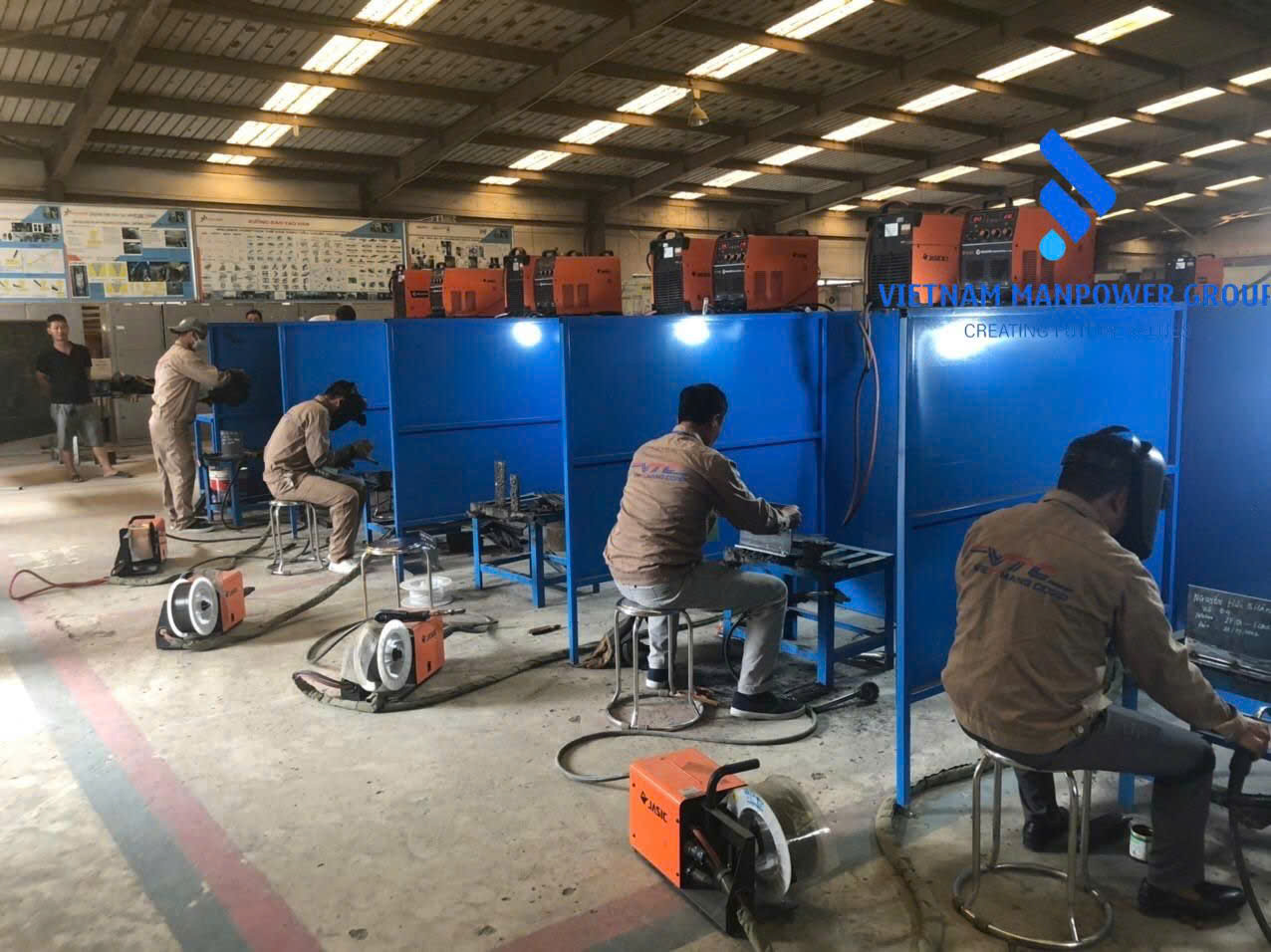
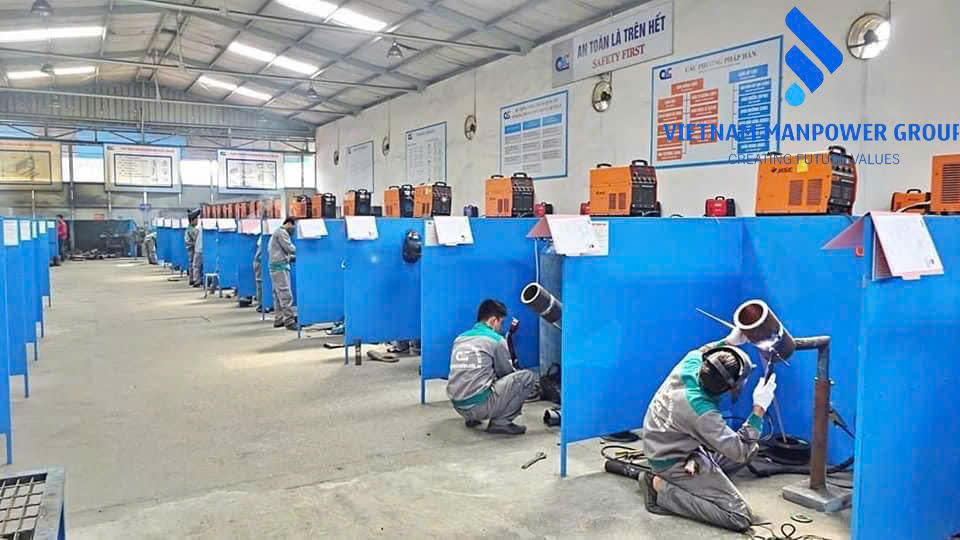
Candidates should complete practical welding tests based on the employer’s actual production procedures. The assessment may cover:
- Welding processes used by the shipyard
- Welding positions and base materials
- Basic reading of welding symbols or technical drawings
- Joint preparation and machine parameter adjustment
- Control of deformation and welding defects
- Weld cleaning and finishing
- Use of personal protective equipment
- Ability to work at height or in confined spaces
South Korean employers should provide the Vietnamese supplier with the practical test requirements in advance, including the welding process, material, plate thickness, welding position, consumables, and evaluation criteria.
This allows the manpower supplier to screen and prepare candidates according to the employer’s actual standards.
Requirements for Ship Electricians and Ship Painters
Ship electricians should understand electrical cables, switchboards, electrical equipment, cable installation, cable tray systems, and shipboard electrical safety procedures.
Ship painters should have experience in surface preparation, industrial spray painting, coating application, paint mixing, layer thickness control, and safe chemical handling.
Both occupations involve specialized and potentially hazardous working environments. Medical examinations, occupational safety training, work-at-height assessment, and confined-space preparation should therefore be carried out carefully.
2. Automotive Component Production and Vehicle Body Repair
South Korea has a highly developed automotive manufacturing industry supported by a multi-tier network of component suppliers.
Labor demand therefore comes not only from major automotive corporations but also from subcontracting factories involved in stamping, welding, assembly, machining, inspection, painting, and product finishing.
Two E7-3 occupations are directly related to this sector:
- Automotive component production workers
- Automotive body repair and painting workers
Vietnamese candidates may be recruited from mechanical factories, automotive workshops, component manufacturers, vocational schools, and technical training centers.
However, manpower suppliers must clearly distinguish production-line workers from automotive body repair technicians. These two groups require different experience and technical skills.
Practical tests may include:
- Spot welding
- Grinding and finishing
- Measurement and inspection
- Surface preparation
- Component installation and removal
- Paint mixing
- Spray painting
- Compliance with production cycle times
- Quality-control procedures
A general job description such as “automotive worker” is not sufficient. Employers should clearly identify the production process, machinery, product type, required experience, and expected skills.
3. Construction Machinery Components and Foundation Industries
The addition of construction machinery component production workers and the pilot introduction of mold and die workers indicate that South Korea is using the E7-3 policy to address skilled labor shortages in foundation manufacturing industries.
Businesses producing excavators, lifting equipment, construction machinery, mechanical assemblies, and industrial components may require:
- Structural welders
- Assembly workers
- Machining workers
- Machine operators
- Quality-control workers
- Industrial painters
- Metal-processing workers
For these occupations, recruitment orders must clearly describe the production stage in which the worker will be employed.
A general title such as “mechanical worker” is too broad for proper candidate screening and may result in an incorrect match between the job, the worker’s experience, and the approved visa occupation.
Employers should provide details about the machinery, materials, production drawings, welding processes, inspection tools, tolerances, and quality requirements involved.
4. Slaughterhouses and Food Processing
The E7-3 category includes two notable slaughter-related occupations:
- Halal slaughter workers
- Livestock and poultry slaughter workers
South Korea’s slaughtering industry has experienced recruitment difficulties due to an aging domestic workforce, physically demanding working conditions, and the limited attractiveness of the occupation among local job seekers.
In July 2026, 36 foreign slaughter workers were scheduled to enter South Korea under the E7-3 visa, including an initial group of 15 workers.
These workers had completed relevant training and had at least three years of occupational experience before being accepted.
This indicates that there is genuine demand for foreign slaughter workers, but the candidate requirements are relatively strict.
Vietnamese manpower agencies should recruit candidates with actual slaughterhouse or meat-processing experience rather than general food-production experience.
Candidates may need to be assessed in the following areas:
- Knife-handling skills
- Safe use of slaughtering tools
- Identification of product sections
- Working speed on processing lines
- Food hygiene
- Cold-environment adaptability
- Machinery safety
- Halal procedures and religious requirements, where applicable
Employers should also explain whether the work involves slaughtering, cutting, deboning, trimming, processing, packaging, or sanitation because these are different job functions.
5. Animal Husbandry and Aquaculture
The E7-3 category includes animal husbandry workers and aquaculture technicians.
These occupations should not be confused with general agricultural labor.
Employers normally require candidates with experience in animal care, feed management, farm sanitation, livestock health observation, equipment operation, water-quality monitoring, or aquaculture facility management.
South Korea has expanded the eligible species and operational scope for aquaculture technicians, reflecting actual demand from regional authorities and seafood businesses.
Vietnam has strong potential in this area because suitable candidates can be recruited from livestock farms, shrimp farms, fish farms, hatcheries, aquaculture businesses, and seafood-production areas.
However, suppliers must verify candidates’ experience through employment documentation, technical interviews, practical questions, and reference checks. A general employment confirmation letter is not sufficient when the position requires specific technical experience.
Potential duties may include:
- Feeding livestock or aquatic species
- Monitoring animal health
- Cleaning farming facilities
- Managing water quality
- Maintaining pumps, aeration systems, or feeding equipment
- Recording production information
- Supporting disease-control procedures
- Handling and transporting products
6. Aviation and Aircraft Component Production
Two E7-3 occupations relate to the aviation industry:
- Aircraft maintenance and repair technicians
- Aircraft or aircraft component production workers
These positions require a higher level of technical competence, quality discipline, traceability, documentation control, and production accuracy.
General mechanical workers should not be recruited as aviation personnel unless they have relevant experience and qualifications.
Employers must clearly determine whether the position involves:
- Aircraft maintenance
- Mechanical assembly
- Aircraft component manufacturing
- Precision machining
- Sheet-metal work
- Composite materials
- Structural assembly
- Electrical systems
- Quality inspection
- Non-destructive testing support
Each production area requires different candidate selection standards.
For example, aircraft maintenance personnel may require relevant technical qualifications or licenses, while production workers may be evaluated through practical experience in precision manufacturing, assembly, or quality-controlled production environments.
7. Electrical Transmission Line Workers
Electrical transmission line work is a high-risk occupation.
Candidates should have practical experience, understand electrical isolation procedures, use appropriate protective equipment, work safely at height, and respond effectively to emergencies.
Employers should assess:
- Physical fitness
- Ability to work at height
- Electrical safety knowledge
- Tool-handling skills
- Use of harnesses and fall-protection systems
- Emergency response awareness
- Team coordination
- Experience with transmission or distribution systems
Because of the safety risks involved, selecting workers without relevant field experience may create serious operational and legal consequences.
8. Musical Instrument Manufacturing and Tuning
Musical instrument manufacturing and tuning is a smaller but highly specialized labor market.
Suitable candidates may come from instrument factories, craft workshops, repair businesses, or specialized production facilities.
Because the occupation requires specific manual skills, recruitment should be based on actual work samples, operation videos, professional interviews, and practical tests rather than mass recruitment.
Employers should specify the type of instrument involved, such as string instruments, pianos, traditional instruments, wind instruments, or other products.
Demand for Vietnamese Workers in South Korea
In 2026, Vietnam and South Korea continued implementing the Employment Permit System, with a plan to select 4,200 Vietnamese workers for manufacturing, fisheries, forestry, and service-sector employment.
This program belongs to the E-9 category rather than E7-3. However, the figures demonstrate that South Korea continues to recruit Vietnamese workers and that both countries have established systems for Korean-language testing, skills evaluation, candidate selection, and pre-departure training.
During the second quarter of 2026, South Korea planned to recruit 15,774 EPS workers from 16 sending countries. Manufacturing, shipbuilding, and mining accounted for 11,275 positions.
These figures are not E7-3 quotas, but they clearly indicate continuing labor pressure in South Korea’s manufacturing and industrial sectors.
E7-3 recruitment is generally more specialized than E-9 recruitment. Individual orders may be smaller, but employers require workers with the correct occupational background, practical experience, technical ability, and visa eligibility.
Why Should South Korean Employers Recruit Vietnamese Skilled Workers?
Vietnam can develop a strong candidate pool for South Korea through vocational schools, manufacturing factories, shipyards, mechanical workshops, training centers, and workers with previous international experience.
The main advantages include:
- Recruitment can be organized by specific occupation.
- Vietnam has an extensive network of vocational schools and practical training centers.
- Candidate sources are available in welding, mechanical engineering, electricity, automotive production, agriculture, aquaculture, and food processing.
- South Korean employers can conduct direct practical tests in Vietnam.
- Korean-language and safety training can be organized before departure.
- The geographical distance between Vietnam and South Korea is suitable for recruitment, testing, inspection, and workforce management.
- Vietnamese workers are familiar with industrial production, teamwork, shift work, and employer-controlled working environments.
However, these advantages are only effective when the manpower supplier can verify experience and maintain recruitment quality.
Recruiting a large number of candidates who do not match the approved occupation may increase the risk of visa rejection, test failure, low productivity, workplace conflict, or early resignation.
Professional E7-3 Skilled Worker Supply Process
Step 1: Analyze the South Korean Employer’s Requirements
The recruitment order should clearly state:
- Occupational code
- Number of workers
- Workplace location
- Production process
- Job description
- Salary
- Working hours
- Overtime conditions
- Accommodation
- Required experience
- Required deployment date
Step 2: Confirm E7-3 Visa Eligibility
The Vietnamese supplier and South Korean partner should confirm whether the proposed position is eligible under E7-3.
They should also verify specific requirements concerning education, experience, industry recommendations, salary, employer eligibility, and recruitment limits.
The South Korean Ministry of Justice publishes E-7 salary standards annually. Employers should not use standards from a previous year when preparing applications for 2026 or later.
Step 3: Candidate Recruitment and Experience Verification
Candidate documents must be checked against actual employment history.
The supplier should verify:
- Employer name
- Previous job title
- Employment period
- Production duties
- Machinery or equipment used
- Practical skills
- Supporting certificates
- Contact information for reference checks
False or unverifiable work experience may significantly affect the visa application.
Step 4: Practical Skills Testing
South Korean employers may travel to Vietnam to conduct direct tests.
Alternatively, testing may be completed through recorded videos, technical documents, online interviews, or supervised practical assessments.
The testing criteria should match the real job rather than relying on a general trade test.
Step 5: Korean-Language and Safety Training
Workers should learn Korean vocabulary related to:
- Tools and machinery
- Production instructions
- Warning signs
- Quality control
- Fire prevention
- First aid
- Personal protective equipment
- Emergency communication
- Workplace commands
Even when a formal Korean-language score is not the main visa requirement, basic communication can significantly improve safety and productivity.
Step 6: Visa Documentation
The South Korean employer and Vietnamese manpower supplier coordinate the preparation of:
- Employment contracts
- Experience certificates
- Educational qualifications
- Vocational certificates
- Personal documents
- Employer documents
- Occupational recommendations
- Immigration application documents
- Other industry-specific records
Step 7: Pre-Departure Orientation
Training should cover:
- South Korean culture
- Labor regulations
- Factory rules
- Contract conditions
- Salary management
- Accommodation rules
- Workplace behavior
- Procedures for reporting accidents or disputes
Step 8: Post-Arrival Support
The manpower supplier should monitor worker adaptation and coordinate with the South Korean employer during the initial employment period.
Support may include:
- Interpretation
- Workplace communication
- Document assistance
- Conflict resolution
- Welfare support
- Coordination with employers and local partners
- Assistance when workers experience difficulties
Criteria for Choosing an E7-3 Manpower Supplier in Vietnam
South Korean employers should evaluate potential partners according to:
- Appropriate operating licenses
- Experience supplying workers to South Korea
- Ability to recruit candidates by occupation
- Practical testing and vocational training facilities
- Capacity to verify employment history
- Korean-language interpreters
- Visa documentation control procedures
- Replacement arrangements for unsuccessful candidates
- Post-departure workforce management
- Transparent recruitment and worker-protection policies
A professional supplier does more than send candidate résumés.
The supplier should help the employer reduce the risks of selecting workers with the wrong occupation, insufficient experience, inadequate practical skills, or unsuitable immigration documentation.
SEO Keywords for South Korean Employers
To help Korean manpower companies and employers find the article, the website should combine Vietnamese, English, and Korean search terms.
Recommended keywords include:
- 베트남 E-7-3 인력 공급업체
- 베트남 숙련공 채용
- 베트남 조선 용접공 채용
- 베트남 선박 전기공
- 베트남 선박 도장공
- 베트남 자동차 부품 생산인력
- 베트남 도축 기술자
- E-7-3 비자 외국인 근로자
- Vietnam E7-3 skilled worker supplier
- Vietnam shipyard welder recruitment
- Korean company hiring Vietnamese workers
- Vietnam manpower agency for Korea
- Vietnamese ship electrician recruitment
- E7-3 workers from Vietnam
- Vietnam skilled labor supplier South Korea
Each occupational group should also have a dedicated landing page rather than placing every keyword into a single article.
Suggested supporting pages include:
- Vietnam Ship Welder Supplier for South Korea
- Vietnamese Ship Electrician Recruitment
- Vietnam Ship Painter Supplier
- Automotive Component Workers from Vietnam
- Vietnamese Slaughterhouse Workers for South Korea
- Vietnam Aquaculture Technician Recruitment
- Aircraft Component Workers from Vietnam
Frequently Asked Questions About the E7-3 Visa
Is E7-3 Available for Every Skilled Worker?
No. E7-3 applies only to occupations included in South Korea’s approved list. The candidate and employer must meet the specific conditions for the relevant occupation.
Are E7-3 and E7-4 the Same?
No. E7-3 is connected to designated occupations. E7-4 is a points-based skilled worker status and is commonly associated with changing the residence status of eligible workers already employed in South Korea.
Which E7-3 Occupations Have Significant Recruitment Potential?
Shipbuilding, automotive component production, construction machinery component production, slaughtering, aquaculture, and certain aviation-related occupations are among the most notable groups.
Must Vietnamese Workers Speak Korean?
The specific requirement depends on the occupation and application. However, basic Korean related to work and safety is highly valuable for productivity, workplace communication, and adaptation.
Can Employers Recruit Candidates Without Experience?
Many E7-3 occupations require relevant experience or professional training.
Recruiting completely inexperienced workers is generally unsuitable, particularly for shipbuilding, slaughtering, aviation maintenance, transmission line work, and other high-risk occupations.
What Documents Should a South Korean Company Prepare?
The company may need to provide:
- Business registration documents
- Recruitment information
- Job descriptions
- Employment contracts
- Salary and working-condition information
- Accommodation details
- Employer eligibility documents
- Immigration or industry-specific supporting documents
The exact requirements depend on the occupation and the regulations in force at the time of application.
Can the List of 14 Occupations Change?
Yes. The E7-3 occupational list may be expanded, revised, restricted, or placed under a pilot scheme.
Employers should check the latest official regulations before each recruitment program.
Conclusion
The supply of Vietnamese skilled workers under the E7-3 visa is a practical solution for South Korean employers seeking qualified personnel in shipbuilding, component manufacturing, automotive production, aviation, electricity, livestock farming, aquaculture, and slaughtering.
For a recruitment program to succeed, employers must first identify the correct occupational code, establish clear selection standards, conduct relevant practical tests, and work with a Vietnamese manpower supplier capable of managing the entire recruitment process.
Vietnamese workers can effectively meet South Korea’s labor requirements when they are recruited for the correct occupation, properly trained, and fully prepared in technical skills, Korean communication, workplace safety, cultural understanding, and legal documentation.
A transparent and professional recruitment system helps South Korean employers select suitable workers, reduce early resignation, improve productivity, minimize immigration risks, and maintain a stable workforce for long-term production.
Please contact us for more details:
☎ Whatsapp: +84 982 0303 66
🌐 Website: vietnammanpower.group
📩 Email: vietnammanpower18@gmail.com
We are happy to assist you!